Why Makers Are Moving Here: Tullahoma's Quiet Rise as a Creative Hub
There's a moment a lot of creative people hit — usually somewhere between their third rent increase and their second side hustle — where they start asking a serious question: Is this city actually working for me?
For a growing number of artists, woodworkers, musicians, potters, photographers, and independent designers, the answer has led them somewhere unexpected. Not Nashville. Not Chattanooga. Tullahoma.
It sounds like a quirky footnote until you start talking to the people who actually made the move. Then it starts sounding like a strategy.
The Math That Changes Everything
Let's start with the obvious part: space is cheap here, at least compared to what creatives are used to fighting over in larger cities.
A working studio in a mid-sized Tennessee city can run anywhere from $800 to well over $1,500 a month once you factor in utilities and the kind of square footage you actually need to work. In Tullahoma, that same budget gets you significantly more room — sometimes a whole building — and the difference between scraping by and running a real operation.
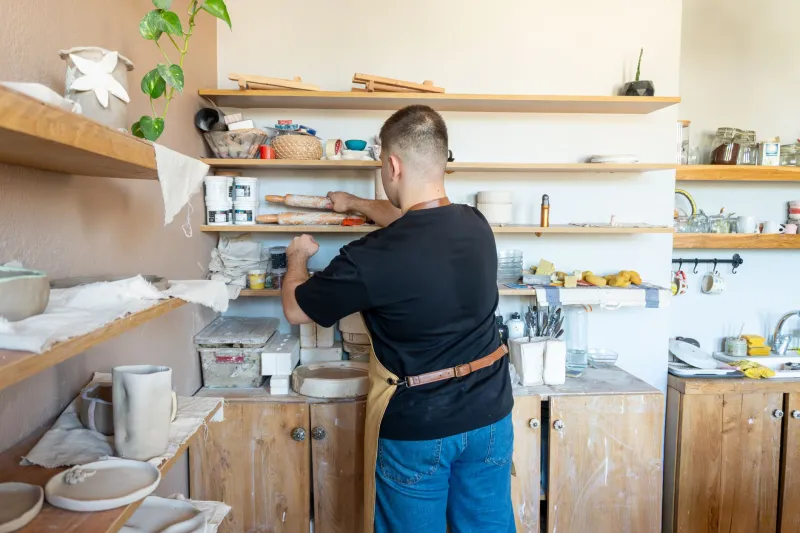
Jessica Harmon, a ceramic artist who relocated from the Nashville area about three years ago, describes the shift plainly. "In Nashville, I had a corner of a shared studio and I was still paying too much for it. Here, I have a dedicated workshop with room for my kiln, a small retail area, and I'm actually making money instead of just breaking even." She sells locally, ships nationally through her website, and teaches weekend workshops — a business model that simply wasn't viable before the move.
That story repeats across disciplines. Furniture makers who needed room for equipment. Photographers who wanted a permanent studio without commercial lease headaches. Musicians who needed a practice and recording space that didn't require earplugs for the neighbors.
Community Without the Competition
Here's something people don't always expect: the creative community in Tullahoma is surprisingly collaborative. In bigger markets, artists in the same niche are often competing for the same clients, the same gallery slots, the same attention. In a smaller town, there's a different dynamic at play.
Marcus Webb, a graphic designer and illustrator who works primarily with local businesses and regional clients, puts it this way: "There's no reason to be territorial here. If somebody needs something I can't do, I send them to someone I trust. That same person sends work back my way. We're building something together."
That informal referral culture extends beyond just creative professionals. Local business owners actively seek out homegrown talent for branding, photography, event planning, and custom work. The result is a small but real local economy that keeps money circulating between makers and the businesses that need what they make.
Inspiration Has an Address
Creative professionals also talk about something harder to quantify: the feeling of the place itself.
Tullahoma sits in a part of Tennessee that doesn't get nearly enough credit for its character. There's the lake. There's the surrounding landscape — the kind that changes enough through the seasons to stay interesting. There's an architectural texture to the older parts of town that photographers and painters find endlessly useful. And there's a pace of life that gives you room to think, which turns out to be something a lot of creative people are desperately short on.
Leah Fontaine, a freelance photographer who shoots everything from commercial work to personal fine-art projects, says the environment feeds her work in ways she didn't anticipate. "I used to think I needed to be in a big city to have access to interesting subjects. But honestly, I've done some of my best work here. The light, the people, the landscape — it's all here. And I'm not exhausted all the time, so I actually have the energy to go out and shoot."
Market Access Isn't What It Used to Be
One concern that sometimes comes up when creatives consider smaller towns is market access — the worry that being away from a major city means being away from buyers, clients, and opportunity.
That concern is increasingly outdated, and makers in Tullahoma will tell you so directly.
E-commerce has flattened geography in ways that genuinely matter for independent creators. A woodworker selling custom furniture, a jeweler with an Etsy shop doing serious volume, a musician licensing tracks for commercial use — none of these businesses require a big-city zip code anymore. What they require is reliable internet, affordable shipping logistics, and enough time and energy to actually do the work. Tullahoma checks all three.
For creators who do need in-person client relationships, the town's location helps more than people realize. Nashville is close enough for a day trip. Huntsville is nearby. Chattanooga is a reasonable drive. You can keep a foot in larger markets without paying to live in them.
What's Still Being Built
To be fair, Tullahoma's creative scene is still developing. It doesn't have the gallery density of a larger city or the kind of established arts infrastructure that comes with decades of institutional investment. There are gaps.
But that's also part of what's drawing people. When a scene is still forming, early arrivals have more influence over what it becomes. Local creators aren't just participating in a creative community here — in a real sense, they're building it.
There are conversations happening around shared maker spaces, pop-up markets, and collaborative events that would give local artists more visibility and more chances to connect with buyers. Some of that is already happening informally. Some of it is in early planning stages. The energy is there.
A Different Kind of Creative Life
The narrative around creative careers has long been tied to big cities — the idea that you have to go somewhere loud and expensive and competitive to be taken seriously. A lot of people in Tullahoma are quietly dismantling that story.
They're running real creative businesses. They're building sustainable practices. They're living in a place they actually like, with overhead they can manage and neighbors who know their names.
It's not the loudest version of a creative life. But it might be one of the smarter ones.